How 2026 IRS 401(k) Limits Alter Backdoor Roth Conversions
Advertisements
Are higher inflation adjustments forcing you to rethink your tax-advantaged wealth strategies? The updated 2026 IRS 401(k) Limits create fresh opportunities for high-earning investors executing indirect Roth conversions to optimize their tax-sheltered growth.
Increased employer-sponsored plan caps directly expand total contribution room, giving savvy savers additional bandwidth for post-tax salary deferrals. Navigating these adjusted thresholds allows high-income earners to maximize non-deductible contributions before executing seamless tax-free rollovers into Roth accounts.
We analyze key IRS threshold changes, mega-backdoor mechanics, and step-by-step conversion strategies to help you capitalize on the new numbers. Read on to refine your retirement portfolio strategy and insulate your long-term wealth from rising tax rates.
Understanding the New 2026 IRS 401(k) Limits
The Internal Revenue Service (IRS) has announced an increase in the 401(k) contribution limit to $23,500 for 2026. This adjustment reflects ongoing efforts to keep pace with inflation and support individuals in saving more for retirement. The new limit provides a greater opportunity for pre-tax or Roth 401(k) contributions.
This increment is not merely a nominal change; it represents a strategic shift in the maximum amount individuals can funnel into their employer-sponsored retirement plans.
Understanding the mechanics of this increase is fundamental for anyone looking to maximize their tax-advantaged savings. The 2026 IRS 401(k) limits directly impact how much capital is available for other retirement vehicles.
For many, this higher ceiling on 401(k) contributions will necessitate a re-evaluation of their overall retirement savings strategy. The implications extend beyond just the 401(k) itself, influencing how other components of a diversified retirement portfolio, including Roth conversions, are managed. The new 2026 IRS 401(k) limits are a key factor in future financial planning.
The Mechanics of the Increase
The IRS typically adjusts contribution limits annually based on cost-of-living increases, as mandated by law. The $23,500 limit for 2026 signifies a recognition of economic shifts and the need for greater retirement savings capacity. This increase allows individuals to shield a larger portion of their income from immediate taxation, or to contribute more to a Roth 401(k).
This upward adjustment provides a tangible benefit for those nearing retirement or high-income earners. The ability to contribute an additional amount can significantly boost retirement nest eggs over time. It also sets a new baseline for future increases, influencing long-term financial projections.
The 2026 IRS 401(k) limits represent a direct response to inflation trends.
This change allows for increased tax-deferred or tax-free growth within 401(k) accounts.
It encourages greater participation and higher savings rates among eligible employees.
Impact on Backdoor Roth Conversion Tactics
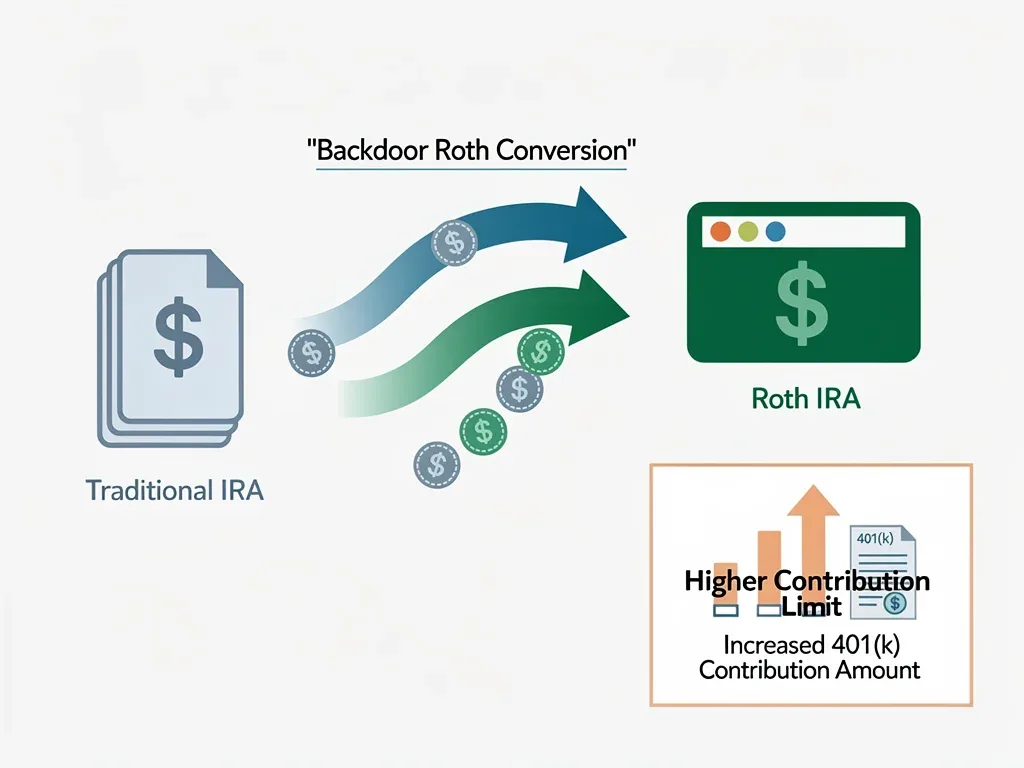
The increased 2026 IRS 401(k) limits have a direct, albeit subtle, impact on backdoor Roth conversion tactics. While the limits for Traditional and Roth IRAs are separate, the overall strategy often involves maximizing all available tax-advantaged accounts.
A higher 401(k) limit means some individuals might allocate more to their 401(k), potentially freeing up other funds or altering their approach to non-deductible IRA contributions.
For high-income earners who are phased out of direct Roth IRA contributions, the backdoor Roth strategy remains vital. The new 401(k) limits could influence their capacity to save in other vehicles, making the backdoor Roth even more attractive for diversifying tax treatment in retirement. Understanding how the 2026 IRS 401(k) limits alter backdoor Roth conversion tactics is paramount.
The interplay between these different retirement vehicles requires careful consideration. Financial advisors will be guiding clients through these adjustments to ensure their strategies remain compliant and optimized. The goal is always to maximize tax efficiency and long-term growth, and the 2026 IRS 401(k) limits play a crucial role in this assessment.
Refining Your Backdoor Roth Strategy
A key aspect of refining your backdoor Roth strategy involves assessing your overall savings capacity. With more room in your 401(k), you might find yourself with additional capital that can be directed towards non-deductible Traditional IRA contributions, which are the first step in a backdoor Roth conversion. This means the 2026 IRS 401(k) limits could indirectly enhance your ability to execute these conversions.
The pro-rata rule remains a critical consideration for backdoor Roth conversions, particularly for those with existing pre-tax IRA balances. Maximizing 401(k) contributions can help keep pre-tax funds within an employer plan, thus simplifying the backdoor Roth process by minimizing the pre-tax IRA balance. This strategic move is directly influenced by the 2026 IRS 401(k) limits.
Evaluate if increased 401(k) contributions free up funds for non-deductible IRA contributions.
Consider rolling existing pre-tax IRAs into your 401(k) to avoid the pro-rata rule.
Consult a financial advisor to integrate the new 2026 IRS 401(k) limits into your comprehensive plan.
Navigating the Pro-Rata Rule with Higher 401(k) Limits
The pro-rata rule is a significant hurdle for many attempting backdoor Roth conversions, especially those with substantial pre-tax IRA balances.
This rule dictates that a portion of any Roth conversion will be taxable if you hold both pre-tax and after-tax IRA funds. The higher 2026 IRS 401(k) limits offer a strategic avenue to mitigate this rule's impact by allowing more funds to be rolled into a 401(k).
By rolling pre-tax IRA funds into a 401(k), individuals can effectively zero out their pre-tax IRA balance. This action ensures that subsequent backdoor Roth conversions of after-tax IRA contributions are entirely tax-free. The increased 401(k) limit makes this strategy more feasible for a broader range of savers.
This maneuver is particularly advantageous for high-income earners who frequently use the backdoor Roth strategy. The ability to consolidate pre-tax assets within a 401(k) simplifies their tax situation and maximizes the efficiency of their Roth conversions. The 2026 IRS 401(k) limits thus become a tool for sophisticated tax planning.

Strategic Consolidation for Tax Efficiency
Strategic consolidation involves moving all pre-tax IRA assets into an employer-sponsored 401(k) plan. This move, often referred to as a "reverse rollover," is permissible if your 401(k) plan allows it. With the higher 2026 IRS 401(k) limits, more individuals will find their 401(k) plans capable of accommodating these larger rollovers, making the strategy more accessible.
Once your traditional IRA is devoid of pre-tax funds, any non-deductible contributions made to it can be converted to a Roth IRA without incurring additional taxes under the pro-rata rule. This streamlines the backdoor Roth process, making it cleaner and more predictable. The 2026 IRS 401(k) limits support this simplification.
Confirm your 401(k) plan allows for incoming rollovers from IRAs.
Execute the reverse rollover of pre-tax IRA funds into your 401(k).
Proceed with non-deductible IRA contributions and subsequent Roth conversions without pro-rata concerns.
Considering the Mega Backdoor Roth Alongside 401(k) Changes
Beyond the traditional backdoor Roth, some individuals have access to a "mega backdoor Roth" strategy, which involves contributing after-tax money to a 401(k) and then converting it to a Roth IRA.
The new 2026 IRS 401(k) limits, specifically the overall limit for combined employee and employer contributions, could influence the effectiveness and availability of this strategy. This requires a deeper dive into overall contribution caps.
The total 401(k) contribution limit, encompassing employee, employer, and after-tax contributions, is significantly higher than the employee-only limit.
As the employee contribution portion increases to $23,500, it potentially reduces the headroom for after-tax contributions if the overall limit remains relatively stable or does not increase proportionally. This nuanced interaction is critical for those leveraging the mega backdoor Roth.
Therefore, individuals utilizing or considering a mega backdoor Roth must carefully evaluate how the 2026 IRS 401(k) limits affect their total contribution capacity. It's not just about the $23,500 employee contribution, but the aggregate limit that truly defines the scope of this advanced strategy. The overall limit for 2026 will be a key figure to watch.
Optimizing After-Tax Contributions
Optimizing after-tax contributions for a mega backdoor Roth requires an understanding of your plan's specifics and the overall IRS limits. If your 401(k) plan allows after-tax contributions and in-service distributions, you can contribute funds beyond the standard employee deferral limit, up to the overall IRS limit. The new 2026 IRS 401(k) limits affect the calculation of this remaining after-tax contribution space.
For example, if the overall limit (employee + employer + after-tax) increases, the higher employee contribution of $23,500 might still leave ample room for after-tax contributions.
However, if the overall limit lags, the increased employee deferral could squeeze the available space for mega backdoor Roth contributions. This highlights the importance of staying informed about all IRS limits.
It is crucial to coordinate with your plan administrator to understand your specific 401(k) plan's rules regarding after-tax contributions and in-service rollovers. Not all plans permit these advanced strategies. The 2026 IRS 401(k) limits require a thorough review of your plan's provisions.
Future-Proofing Your Retirement with 2026 IRS 401(k) Limits
Future-proofing your retirement strategy involves anticipating regulatory changes and adapting proactively. The 2026 IRS 401(k) limits serve as a reminder that retirement planning is not a static process; it requires continuous monitoring and adjustment. Integrating these new limits into your long-term financial projections is vital for maintaining a robust and tax-efficient retirement portfolio.
One key aspect of future-proofing is to diversify your retirement savings across different tax treatments. This includes traditional pre-tax accounts, tax-free Roth accounts, and potentially taxable brokerage accounts. The ability to contribute more to a 401(k) under the new 2026 IRS 401(k) limits enhances your capacity to build a diversified portfolio.
Furthermore, staying informed about potential future legislative changes beyond the 2026 IRS 401(k) limits is equally important. Retirement laws can evolve, and proactive planning can help mitigate any adverse impacts. Regular consultations with a qualified financial advisor are essential to navigate this dynamic landscape effectively.
Adapting to Regulatory Landscapes
Adapting to regulatory landscapes means being flexible with your financial plans. The increase in 2026 IRS 401(k) limits is just one example of how governmental policies can influence individual savings strategies. Successful retirement planning involves understanding these shifts and adjusting your contributions and conversions accordingly to maximize benefits.
For instance, if future legislation were to further restrict Roth conversions or alter the tax treatment of retirement accounts, those who have diversified their savings and optimized their contributions under the current 2026 IRS 401(k) limits would be better positioned to adapt. Proactive adjustments reduce the risk of being caught off guard by new rules.
Regularly review your retirement plan with a financial professional to incorporate new regulations.
Diversify your retirement assets across various account types to minimize tax risk.
Stay updated on IRS announcements and potential legislative changes affecting retirement savings.
The Role of Professional Financial Advice
Navigating the complexities of retirement planning, especially with changes like the 2026 IRS 401(k) limits, underscores the critical role of professional financial advice.
A qualified financial advisor can provide personalized guidance tailored to your unique financial situation, risk tolerance, and retirement goals. Their expertise ensures that you are making informed decisions that align with your long-term objectives.
An advisor can help you understand the intricate details of how the 2026 IRS 401(k) limits alter backdoor Roth conversion tactics, analyze your specific eligibility for various strategies, and assist with the technical aspects of rollovers and conversions. This professional insight is invaluable in optimizing your retirement savings and avoiding common pitfalls.
Beyond just compliance, financial advisors can help you develop a holistic financial plan that integrates your 401(k), IRAs, and other investment vehicles. They can also help project the long-term impact of current decisions, ensuring that your strategy is robust and sustainable. The 2026 IRS 401(k) limits are a prime example of why expert guidance is beneficial.
Choosing the Right Advisor
Choosing the right financial advisor is a crucial step in effectively managing your retirement savings. Look for an advisor who specializes in retirement planning and has a deep understanding of IRS regulations, including how the 2026 IRS 401(k) limits impact various strategies. A fee-only fiduciary advisor is often recommended, as they are legally obligated to act in your best interest.
Interview potential advisors to ensure their philosophy aligns with your financial goals and values. Ask about their experience with backdoor Roth conversions and how they approach integrating new IRS limits into client portfolios.
The right advisor will be a partner in your financial journey, helping you navigate changes like the 2026 IRS 401(k) limits with confidence.
Seek advisors with expertise in retirement planning and tax-advantaged accounts.
Prioritize fee-only fiduciaries for unbiased advice.
Ensure the advisor understands and can effectively implement strategies around the 2026 IRS 401(k) limits.
Understanding the Broader Economic Context
The increase in the 2026 IRS 401(k) limits does not occur in isolation; it is part of a broader economic context influenced by inflation, interest rates, and overall market performance.
These macroeconomic factors play a significant role in how effective retirement savings strategies will be. A higher 401(k) limit can be particularly impactful during periods of sustained inflation, as it allows individuals to save more in tax-advantaged accounts.
Moreover, interest rate environments can affect the growth potential of your retirement savings. While 401(k) contributions are often invested in diversified portfolios, the overall economic climate dictates the returns. The new 2026 IRS 401(k) limits provide more capital to be invested, potentially amplifying returns in favorable market conditions.
Understanding this broader context helps in making informed decisions about not just how much to contribute, but also where and how to invest those contributions. The 2026 IRS 401(k) limits are a piece of a larger puzzle that financial planners and individuals must consider for optimal outcomes.
Inflation and Purchasing Power
Inflation directly erodes the purchasing power of future retirement income. The IRS's decision to increase the 2026 IRS 401(k) limits is a mechanism to combat this erosion by allowing more money to grow tax-deferred or tax-free.
This helps ensure that the real value of your retirement savings is preserved over time, making the new limits even more crucial.
By contributing more to your 401(k), you are effectively hedging against future inflationary pressures. This strategy helps maintain your desired lifestyle in retirement, even as the cost of living rises. The 2026 IRS 401(k) limits are a proactive measure to support long-term financial security.
Key Point | Brief Description |
|---|---|
401(k) Limit Increase | IRS raises 401(k) contribution limit to $23,500 for 2026, boosting savings potential. |
Backdoor Roth Impact | New limits influence non-deductible IRA contributions and pro-rata rule management. |
Pro-Rata Rule Strategy | Higher 401(k) limits facilitate reverse rollovers to mitigate pro-rata taxation. |
Mega Backdoor Roth | Overall 401(k) limits affect after-tax contribution space for this advanced strategy. |
Frequently Asked Questions About 2026 IRS 401(k) Limits
How will the 2026 IRS 401(k) limits affect my current retirement plan?▼
The increased 2026 IRS 401(k) limits mean you can contribute more to your employer-sponsored retirement account, potentially accelerating your savings growth. This may require adjusting your current contribution percentages or re-evaluating your overall asset allocation strategy to maximize the new limits effectively.
Can the new 401(k) limits simplify my backdoor Roth conversions?▼
Yes, for some. The higher 2026 IRS 401(k) limits can make it easier to roll pre-tax IRA funds into your 401(k), effectively reducing or eliminating your pre-tax IRA balance. This simplifies the pro-rata rule calculation, making subsequent backdoor Roth conversions more tax-efficient and straightforward.
What is the "mega backdoor Roth" and how do the new limits impact it?▼
A mega backdoor Roth involves contributing after-tax money to your 401(k) and then converting it to a Roth IRA. The new 2026 IRS 401(k) limits, specifically the overall contribution cap, will determine the available space for these after-tax contributions, requiring careful calculation and plan review.
Should I consult a financial advisor regarding these changes?▼
Absolutely. Navigating the nuances of the 2026 IRS 401(k) limits and their impact on complex strategies like backdoor Roth conversions benefits greatly from professional guidance. A financial advisor can help you tailor a strategy that aligns with your specific financial goals and ensures compliance with all regulations.
Will these new limits affect my eligibility for other tax deductions?▼
While the 2026 IRS 401(k) limits directly pertain to contribution amounts, maximizing your 401(k) can influence your adjusted gross income (AGI). A lower AGI might impact your eligibility for certain tax deductions or credits, so it's essential to consider the broader tax implications with your tax professional.
Impact and Implications
The increase in the 2026 IRS 401(k) limits to $23,500 represents a significant development for retirement savers. This adjustment not only offers a greater capacity for tax-advantaged growth but also necessitates a strategic re-evaluation of how individuals approach backdoor Roth conversions.
Financial professionals and savers alike must stay vigilant, monitoring further IRS guidance and legislative changes to optimize their retirement planning in this evolving landscape. The changes underscore the dynamic nature of financial regulations and the continuous need for adaptive strategies.