Refinancing 30-Year Mortgage: 5.75% and 28-Month Breakeven Analysis
Advertisements
Evaluating whether replacing your existing home loan terms makes financial sense requires looking beyond the lower interest rate banner. Initiating a mortgage refinance to secure a 5.75% fixed rate on a 30-year term offers meaningful payment relief, but success hinges on calculating your exact cost recovery timeline.
Calculating your 28-month breakeven threshold ensures the cumulative monthly interest savings comfortably exceed upfront closing fees and origination points. Factoring in loan origination costs, appraisal charges, and your planned tenure in the property prevents homeowners from resetting their debt amortization schedule prematurely.
Analyzing your payback window guarantees that restructuring your residential financing builds true long-term home equity. Here is how to evaluate closing fee structures, calculate your monthly savings, and determine if a 5.75% rate swap aligns with your financial goals.
Understanding the Breakeven Analysis in Mortgage Refinancing
A breakeven analysis in mortgage refinancing is a fundamental tool used to determine how long it will take for the savings from a lower interest rate to offset the costs associated with the refinancing process.
This calculation is vital because refinancing, while potentially beneficial, is not without its expenses. These upfront costs can include appraisal fees, loan origination fees, title insurance, and other closing costs.
Without a clear understanding of the breakeven point, homeowners risk refinancing only to find that the costs negate any perceived savings, especially if they plan to sell their home before reaching that point.
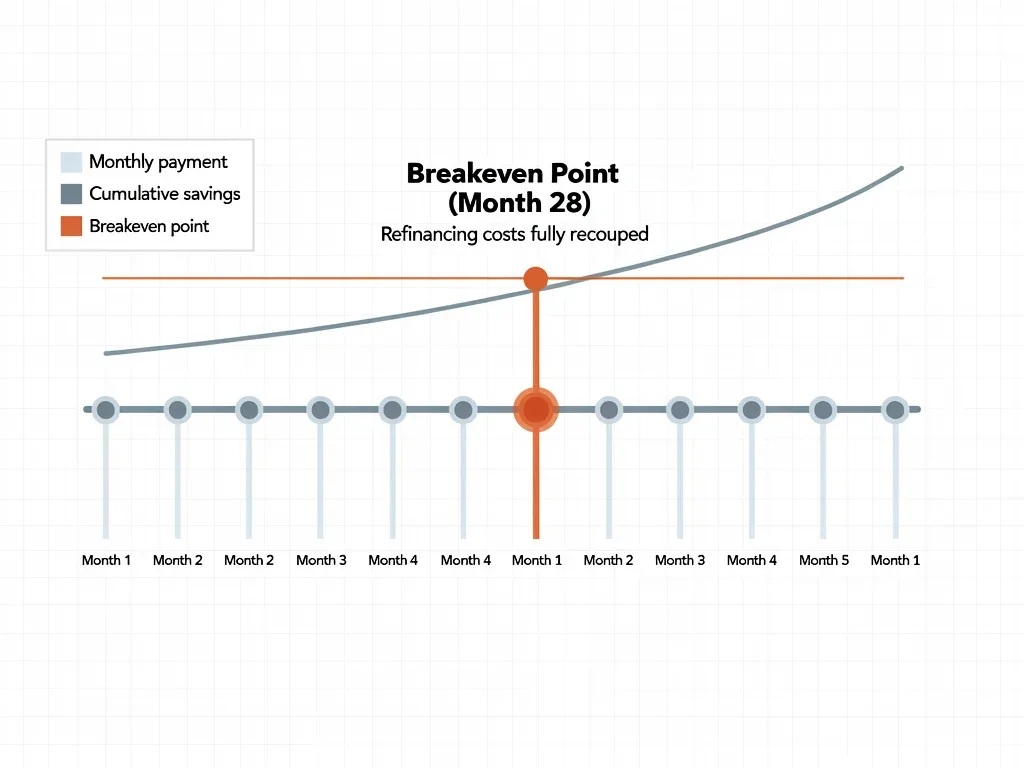
The 28-month figure, in the context of refinancing a 30-year mortgage down to 5.75%, suggests a specific scenario where the combined effect of lower payments and upfront costs balances out over that period. This makes a mortgage refinance breakeven calculation indispensable.
The objective is to ensure that the cumulative savings from the lower monthly payments eventually surpass the total refinancing expenses. If a homeowner sells or refinances again before reaching the breakeven point, they might end up losing money rather than saving it.
This highlights the strategic importance of a detailed breakeven analysis for anyone considering a mortgage refinance breakeven strategy.
Key Components of Refinancing Costs
Refinancing a mortgage involves several costs that must be factored into the breakeven analysis. These typically range from 2% to 5% of the loan amount, significantly impacting the time it takes to recoup the investment. Understanding each component is crucial for an accurate mortgage refinance breakeven calculation.
These costs can vary depending on the lender, the loan amount, and the specific state or local regulations.
Homeowners should request a detailed breakdown of all fees from their lender to ensure a comprehensive understanding of the total expense. Ignoring any of these elements could lead to an inaccurate breakeven estimate, undermining the goal of a successful mortgage refinance breakeven strategy.
Loan Origination Fees: Charges by the lender for processing the new loan.
Appraisal Fees: Cost for an independent assessment of the home's value.
Title Insurance: Protects the lender and homeowner against title defects.
Escrow Fees: Charges for services related to closing the loan.
Calculating Monthly Savings at 5.75%
The allure of refinancing often stems from the promise of lower monthly payments. When a 30-year mortgage is refinanced down to a 5.75% interest rate, the monthly savings can be substantial, depending on the original interest rate and the remaining loan balance. These savings form the other side of the breakeven equation, directly offsetting the refinancing costs.
To accurately calculate these savings, homeowners need to compare their current monthly principal and interest payment with the projected payment at the new 5.75% rate.
Online mortgage calculators can provide estimates, but a precise calculation requires inputting the exact new loan amount and interest rate. This step is fundamental for a sound mortgage refinance breakeven analysis.
It is important to remember that only the principal and interest portion of the payment contributes to direct savings from a lower rate. Property taxes and homeowners insurance, while part of the total monthly housing expense, are generally unaffected by the interest rate change. This distinction is vital for an accurate mortgage refinance breakeven assessment.
The Significance of a 28-Month Breakeven Period
A 28-month breakeven period is a relatively short timeframe in the context of a 30-year mortgage, making it an attractive target for many homeowners.
This period suggests that within just over two years, the accumulated monthly savings will have fully covered the initial refinancing costs. For those planning to stay in their homes for the medium to long term, this makes the refinance a financially sound decision.
The specific figure of 28 months for a mortgage refinance breakeven indicates that the combination of the new 5.75% rate and the associated closing costs results in a favorable recoupment period.
This short breakeven point is particularly appealing in dynamic economic environments, where future interest rate movements or personal financial changes are uncertain. It provides a quicker return on the refinancing investment.
Moreover, a 28-month breakeven offers flexibility. Homeowners who achieve this point quickly gain the benefit of lower payments for the remainder of their loan term, without the lingering burden of having to recoup substantial upfront costs. This makes the mortgage refinance breakeven strategy highly effective.
Factors Influencing the Breakeven Point
Several variables can significantly impact how long it takes to reach the breakeven point. Understanding these factors is crucial for homeowners to accurately project their own mortgage refinance breakeven timeline. Even small changes in these variables can alter the breakeven period substantially.
The total amount of closing costs is a primary driver; higher costs naturally extend the breakeven period. Conversely, larger monthly savings due to a significant drop in the interest rate will shorten the time to recoup those costs.
Homeowners must meticulously evaluate each of these elements to arrive at a realistic mortgage refinance breakeven estimate.
Current Interest Rate: A higher starting rate means greater potential savings, shortening the breakeven.
New Interest Rate: Securing a significantly lower rate, like 5.75%, maximizes monthly savings.
Loan Amount: Larger loan amounts mean larger potential savings, but also potentially higher closing costs.
Closing Costs: The total sum of all fees incurred during the refinancing process.

When a 28-Month Breakeven is Ideal
A 28-month breakeven period is particularly ideal for homeowners who anticipate staying in their current home for at least two to three years, and ideally much longer.
This timeframe ensures that they will not only recoup their initial investment but also enjoy significant net savings over the remaining life of the loan. It offers a balance between immediate cost and long-term benefit for a mortgage refinance breakeven.
For those with stable job situations and no immediate plans to relocate, achieving a breakeven within 28 months provides peace of mind and tangible financial advantages. It transforms the refinancing process from a speculative move into a calculated financial improvement. This makes the mortgage refinance breakeven particularly attractive.
Conversely, if a homeowner expects to sell their property within a shorter period, a 28-month breakeven might not be advantageous. In such cases, the costs of refinancing might not be fully recouped, leading to a net financial loss. Therefore, personal circumstances and future plans are paramount when evaluating a mortgage refinance breakeven.
The Mechanics of Refinancing to 5.75%
Refinancing a 30-year mortgage to 5.75% involves a series of steps, starting with assessing your current financial standing and creditworthiness.
Lenders will evaluate your credit score, debt-to-income ratio, and employment history to determine eligibility and the best possible rate. A strong financial profile is key to securing favorable terms and a desirable mortgage refinance breakeven.
Once pre-approved, homeowners will need to gather necessary documentation, including income verification, asset statements, and current mortgage details.
The application process will then move to underwriting, where the lender thoroughly reviews all submitted information to approve the loan. This systematic approach ensures a smooth transition to a lower rate, optimizing the mortgage refinance breakeven.
The closing phase involves signing all new loan documents and paying the associated closing costs. It is crucial to review all documents carefully before signing to ensure that the terms, especially the 5.75% interest rate and all fees, match what was agreed upon. This meticulous attention to detail is vital for a successful mortgage refinance breakeven.
Navigating the Application Process
The application process for refinancing can be streamlined by being well-prepared. Having all necessary documents organized and readily available can significantly reduce delays.
Lenders typically require recent pay stubs, W-2 forms, tax returns, bank statements, and a copy of your current mortgage statement. This preparation aids in a quicker mortgage refinance breakeven.
Communicating openly and promptly with your lender is also essential. Responding quickly to requests for additional information or clarification can keep the process moving forward efficiently. Any delays can prolong the time until you start realizing savings, thereby impacting your mortgage refinance breakeven.
Comparing offers from multiple lenders is a smart strategy. Different lenders may offer slightly different rates, fees, and terms, which can collectively influence your breakeven point. Shopping around ensures you secure the most advantageous deal for your mortgage refinance breakeven goal.
Impact of Credit Score and Debt-to-Income Ratio
Your credit score plays a pivotal role in determining the interest rate you qualify for when refinancing. A higher credit score signals lower risk to lenders, making you eligible for more competitive rates, such as the desired 5.75%. Conversely, a lower score might result in a higher rate or even an inability to refinance, directly affecting the mortgage refinance breakeven.
Similarly, your debt-to-income (DTI) ratio is a crucial metric. Lenders use it to assess your ability to manage monthly payments. A lower DTI ratio indicates that you have sufficient income to cover your debts, making you a more attractive borrower. This positively influences the terms you can secure, including the interest rate, and subsequently, your mortgage refinance breakeven.
Before initiating the refinancing process, it is advisable to check your credit report for any inaccuracies and take steps to improve your credit score if necessary. Reducing existing debt can also lower your DTI ratio, strengthening your application and increasing your chances of achieving a favorable 5.75% rate for your mortgage refinance breakeven.
Potential Pitfalls and How to Avoid Them
While refinancing to a lower interest rate like 5.75% can be highly beneficial, there are potential pitfalls that homeowners must be aware of.
One common mistake is focusing solely on the interest rate without considering the total closing costs. High closing costs can significantly extend the breakeven period, making the refinance less advantageous than it initially appears.
Another pitfall is extending the loan term unnecessarily. If you are several years into your original 30-year mortgage and refinance into a new 30-year term, you might end up paying more interest over the long run, even with a lower rate. This can undermine the financial benefits, making the mortgage refinance breakeven less impactful.
Failing to account for future financial plans, such as selling the home or experiencing a change in income, can also lead to issues. A thorough breakeven analysis must align with your anticipated long-term financial trajectory. Careful planning is essential to avoid these common traps and ensure a successful mortgage refinance breakeven.
Hidden Costs and Fees to Scrutinize
Beyond the standard closing costs, some hidden fees can surprise homeowners if they are not careful. These can include discount points paid to lower the interest rate, which, while beneficial for the rate, add to the upfront expense. It is crucial to understand whether these points are truly worth the investment for your mortgage refinance breakeven.
Prepayment penalties on your existing mortgage, though less common now, can also be a significant hidden cost. Review your current loan documents to ensure you won't incur such penalties when paying off your old mortgage. Awareness of these potential charges is key to an accurate mortgage refinance breakeven calculation.
Additionally, some lenders might bundle certain services, making it difficult to discern individual costs. Always ask for an itemized list of all fees and question anything that seems unclear or unusually high. Transparency in all financial dealings is critical for a favorable mortgage refinance breakeven.
The Risk of Extending Your Loan Term
One of the most significant risks in refinancing is inadvertently extending your loan term, even if you secure a lower interest rate. If you've already paid down a portion of your original 30-year mortgage, say for five years, and then refinance into a new 30-year loan, you're effectively resetting the clock.
This means you'll be paying interest for a longer overall period, potentially negating the savings from the lower rate and affecting your mortgage refinance breakeven.
For example, if you've paid on your mortgage for five years and refinance into a new 30-year term, you're now looking at 35 years of payments in total.
While the monthly payment might be lower, the cumulative interest paid over 35 years could be higher than if you had simply continued with your original loan for the remaining 25 years. This scenario can severely impact the effectiveness of a mortgage refinance breakeven.
To mitigate this risk, consider refinancing into a shorter term, such as a 15-year or 20-year mortgage, if your budget allows. This can significantly reduce the total interest paid and accelerate your equity build-up, making the mortgage refinance breakeven more beneficial in the long run. Always weigh the total cost of interest over the life of the loan.
Long-Term Benefits Beyond the Breakeven Point
Once the 28-month breakeven point is reached, the benefits of refinancing to a 5.75% interest rate truly begin to accumulate.
From this point forward, every monthly payment at the lower rate contributes directly to net savings. These savings can be substantial over the remaining decades of the loan, freeing up funds for other financial goals or investments.
Beyond the direct financial savings, a lower interest rate can also provide a sense of financial stability and peace of mind. Reduced monthly payments make budgeting easier and can alleviate financial stress, especially during times of economic uncertainty. This long-term advantage is a key reason why a detailed mortgage refinance breakeven analysis is so important.
Furthermore, the cumulative effect of lower payments can lead to faster equity growth, particularly if you apply some of the monthly savings to extra principal payments. This accelerated equity build-up enhances your overall financial position and provides greater flexibility in the future. The initial mortgage refinance breakeven period sets the stage for these enduring benefits.
Accelerated Equity Growth and Financial Freedom
A lower interest rate, particularly 5.75% on a 30-year mortgage, can significantly accelerate equity growth. With more of your monthly payment going towards principal rather than interest, you build equity in your home at a faster pace. This is a crucial, often overlooked, benefit of a successful mortgage refinance breakeven.
The financial freedom gained from reduced monthly payments can be channeled into various avenues. Homeowners might choose to pay down other high-interest debts, build an emergency fund, or invest in retirement.
This strategic allocation of savings enhances overall financial health, demonstrating the power of a well-executed mortgage refinance breakeven.
This increased equity and financial flexibility can open doors to future opportunities, such as funding home renovations, supporting educational goals, or even purchasing investment properties. The initial mortgage refinance breakeven pays dividends in the form of enhanced financial capabilities for years to come.
Market Conditions and Future Rate Expectations
The decision to refinance is heavily influenced by current market conditions and expectations for future interest rates.
Securing a 5.75% rate when rates are generally trending upwards can be a strategic move, locking in a favorable rate before they climb further. This forward-thinking approach enhances the value of your mortgage refinance breakeven.
Conversely, if rates are expected to fall significantly in the near future, waiting might be a more prudent strategy, provided your current rate isn't excessively high.
However, predicting market movements is challenging, which underscores the importance of acting on current favorable conditions, especially when a 28-month mortgage refinance breakeven is achievable.
Consulting with financial advisors and staying informed about economic forecasts can help homeowners make timely decisions. The goal is to maximize savings over the long term, and a well-timed refinance with a clear mortgage refinance breakeven can be a powerful tool in achieving that objective, regardless of market volatility.
Key Point | Brief Description |
|---|---|
Breakeven Analysis | Calculates time needed for savings to offset refinancing costs. |
28-Month Target | An ideal timeframe for recouping costs when refinancing to 5.75%. |
Refinancing Costs | Includes origination fees, appraisal, and title insurance. |
Long-Term Benefits | Significant savings, accelerated equity, and financial freedom post-breakeven. |
Frequently Asked Questions About Mortgage Refinancing
What exactly is a mortgage refinance breakeven analysis?▼
A mortgage refinance breakeven analysis determines the period required for the savings from your new, lower interest rate to cover the upfront costs of refinancing. It's crucial for understanding the true financial benefit of the refinance, especially when considering a 5.75% rate for a 30-year mortgage.
Why is a 28-month breakeven point significant for a 5.75% rate?▼
A 28-month breakeven point is significant because it represents a relatively quick return on investment for refinancing. It indicates that within just over two years, your monthly savings from the 5.75% rate will have fully offset the closing costs, making the refinance financially viable for most homeowners.
What are the typical costs associated with refinancing a mortgage?▼
Refinancing costs generally include loan origination fees, appraisal fees, title insurance, and various other closing costs. These can range from 2% to 5% of the loan amount and directly impact your mortgage refinance breakeven calculation, so a detailed breakdown is essential.
How can I ensure an accurate mortgage refinance breakeven calculation?▼
To ensure an accurate breakeven calculation, meticulously gather all your current mortgage details, obtain a comprehensive list of all potential refinancing costs from your lender, and precisely calculate your monthly savings at the new 5.75% rate. Online calculators can assist, but verified figures are best.
What factors besides interest rates should I consider when refinancing?▼
Beyond interest rates, consider your long-term plans for the home, your current credit score, debt-to-income ratio, and the total closing costs. Also, be wary of extending your loan term unnecessarily. These factors all influence the overall financial benefit and the effectiveness of your mortgage refinance breakeven.
Looking Ahead: Strategic Financial Planning with Refinancing
The decision to refinance a 30-year mortgage down to 5.75% and the ensuing 28-month breakeven analysis represent a pivotal moment in personal finance. It underscores the necessity of strategic planning and meticulous calculation to ensure long-term financial gain.
Homeowners who successfully navigate this process position themselves for significant savings and increased financial flexibility. This strategic move, supported by a clear understanding of the mortgage refinance breakeven, can free up capital for other investments, debt reduction, or simply enhance monthly cash flow.
As economic conditions continue to evolve, staying informed about interest rate trends and personal financial health remains paramount. The insights gained from a thorough mortgage refinance breakeven analysis will serve as a valuable guide for future financial decisions, ensuring that your home remains a cornerstone of your financial stability and growth.