The 2026 RESP Contribution Limit: Insider Knowledge on Maximizing Government Grants for Your Child’s Post-Secondary Education
Advertisements

Are you looking for the most effective way to fund your child’s post-secondary education without overstretching your budget? Understanding the 2026 RESP Contribution Limit and matching rules is the single best strategy to secure thousands in free federal funding.
While there is no annual ceiling on deposits, contributing $2,500 per beneficiary unlocks the full $500 annual Canada Education Savings Grant (CESG) match.
Knowing how to navigate these deposit thresholds ensures you maximize government incentive top-ups while avoiding the lifetime $50,000 penalty zone.
In this guide, we reveal smart catch-up strategies, grant matching criteria, and exact timeline steps for Canadian families in 2026. Take control of your Registered Education Savings Plan today and set your child up for academic success.
Understanding the 2026 RESP Contribution Limit
The Registered Education Savings Plan (RESP) remains a cornerstone of post-secondary education funding for Canadian families.
As we approach 2026, understanding the nuances of contribution limits and associated government grants becomes increasingly vital for effective financial planning.
Families often seek clarity on how to best leverage these savings vehicles to ensure their children have access to higher education without incurring substantial debt. The 2026 RESP Contribution Limit, while not a dramatic shift in core structure, necessitates a strategic approach to maximize benefits.
Current projections and expert analyses suggest that while the lifetime contribution limit per beneficiary is expected to remain stable, understanding how annual contributions interact with grant eligibility is key.
This knowledge empowers parents and guardians to make informed decisions that directly impact their child’s educational future.
Maximizing Government Grants: The CESG
The Canada Education Savings Grant (CESG) is a primary incentive for contributing to an RESP, offering a significant boost to savings. This grant provides a matching contribution from the government, making it indispensable for maximizing the value of your RESP.
For most families, the basic CESG provides 20 cents on every dollar contributed to an RESP, up to an annual maximum of $500 per beneficiary. This grant is available until the end of the calendar year the beneficiary turns 17, underscoring the importance of early and consistent contributions.
There are also additional CESG amounts for middle and low-income families, providing an extra 10% or 20% on the first $500 contributed annually.
Understanding these tiers is crucial for qualifying families to further optimize their grant accumulation alongside the 2026 RESP Contribution Limit.
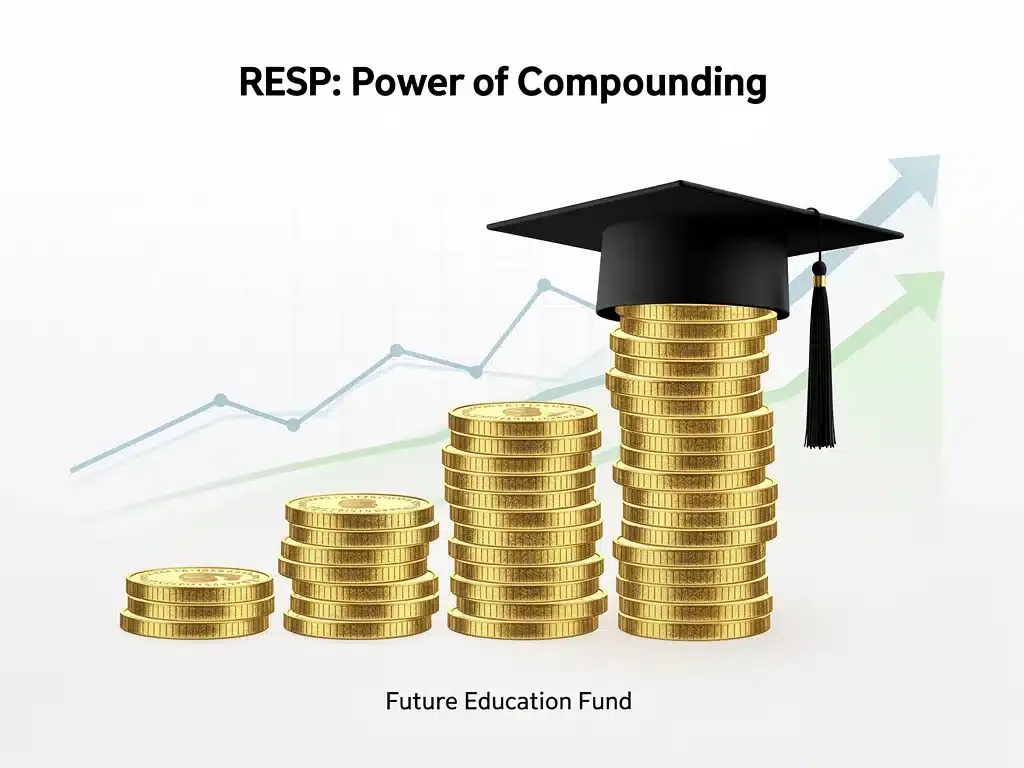
Strategic Contributions: Timing and Limits
Effective management of your RESP involves more than just contributing; it requires strategic timing to fully capitalize on available grants. While there isn’t an annual contribution limit, the lifetime limit and annual grant maximums dictate optimal contribution strategies.
The lifetime RESP contribution limit per beneficiary is $50,000, a figure that has remained consistent for several years. However, the key lies in understanding how to contribute up to this amount while ensuring you receive the maximum possible CESG over the years.
To maximize the CESG, families should aim to contribute at least $2,500 annually per beneficiary to receive the full $500 basic grant.
If you miss a year, you can carry forward unused CESG eligibility, allowing you to catch up on grants in subsequent years, up to a maximum of $1,000 in CESG per year.
Catching Up on Unused CESG
Unused CESG room accumulates, allowing families to contribute more than $2,500 in a given year to claim grants from previous years. This catch-up mechanism is a powerful tool for those who start RESP contributions later or have fluctuating incomes.
For instance, if you haven’t contributed to an RESP for several years, you could contribute $5,000 in one year to receive $1,000 in CESG (the current year’s $500 plus $500 from a previous year). This strategy is vital for maximizing the 2026 RESP Contribution Limit and grants.
Remember that the maximum lifetime CESG is $7,200 per beneficiary. Planning your contributions to reach this maximum before the beneficiary turns 17 is a cornerstone of effective RESP management.
The Canada Learning Bond (CLB)
Beyond the CESG, the Canada Learning Bond (CLB) offers additional financial support to low-income families. Unlike the CESG, no personal contributions are required to receive the CLB, making it a crucial resource for eligible Canadians.
The CLB provides an initial $500 to eligible beneficiaries, followed by $100 for each year of eligibility until the child turns 15, up to a maximum of $2,000. This grant is deposited directly into the child’s RESP, growing tax-free over time.
Eligibility for the CLB is based on family net income and the number of children in the household. Ensuring you apply for and receive these funds is a straightforward way to boost your child’s education savings, complementing strategies around the 2026 RESP Contribution Limit.
Types of RESP Plans and Their Implications
Understanding the different types of RESP plans available can significantly impact how you manage your contributions and access funds. Each plan type has specific features that may better suit different family structures and financial goals.
Individual plans are for a single beneficiary, and anyone can open one for any child. Family plans, on the other hand, allow multiple beneficiaries who must be related by blood or adoption to the subscriber, offering flexibility for families with more than one child.
Group plans are less common now but pool contributions from many subscribers, often with specific contribution schedules and investment strategies.
Choosing the right plan type is a fundamental decision that affects how you interact with the 2026 RESP Contribution Limit and grant rules.
Individual vs. Family Plans: A Closer Look
Individual plans offer simplicity and direct control over a single child’s education savings. They are suitable for single-child families or when a subscriber wishes to save for a non-related child.
Family plans provide greater flexibility, especially if one child decides not to pursue post-secondary education or requires less funding.
The accumulated funds and grants can be transferred to other beneficiaries within the family plan, subject to certain conditions and the overall 2026 RESP Contribution Limit.
However, family plans also have specific rules regarding age limits and grant eligibility for older beneficiaries. It’s essential to consult with a financial advisor to determine which plan best aligns with your family’s unique circumstances and long-term educational aspirations.
Withdrawals and Tax Implications
When the time comes for your child to attend post-secondary education, understanding the withdrawal process and tax implications is paramount.
RESP withdrawals are categorized into two main types: Post-Secondary Education (PSE) payments and Educational Assistance Payments (EAPs).
PSE payments are withdrawals of your original contributions, which are not taxed because you already paid tax on that money. These can be withdrawn by the subscriber or the beneficiary, depending on the plan terms and the institution’s requirements.
EAPs consist of the CESG, CLB, and the investment income earned within the RESP. These payments are taxable in the hands of the student, who typically has little or no other income, resulting in minimal or no tax payable.
This tax advantage is a key benefit of the RESP, especially when considering the 2026 RESP Contribution Limit and its growth potential.
Monitoring Changes to the RESP Landscape
While the core structure of the RESP is generally stable, government policies and economic conditions can influence future adjustments. Staying informed about potential legislative changes is crucial for proactive financial planning.
The Canadian government periodically reviews and updates programs to ensure they remain relevant and effective. While no major changes to the 2026 RESP Contribution Limit are currently projected, minor adjustments to grant mechanisms or eligibility criteria could occur.
Subscribing to financial news, consulting with financial advisors, and checking government websites regularly are effective ways to stay abreast of any developments. This proactive approach ensures that families can adapt their strategies to continue maximizing their education savings.
Planning Beyond 2026: Long-Term Strategies
Effective RESP planning extends beyond immediate contribution limits and grant eligibility; it encompasses a long-term vision for your child’s financial future. Integrating your RESP strategy with other financial goals is essential for holistic wealth management.
Consider how your RESP contributions fit into your overall savings plan, including retirement savings and other investment goals. A balanced approach ensures that you are adequately preparing for all significant life events, not just education.
Regularly review your RESP investment portfolio to ensure it aligns with your risk tolerance and time horizon.
As your child approaches post-secondary education, gradually shifting towards more conservative investments can help protect accumulated savings, ensuring the 2026 RESP Contribution Limit contributions are secure.
| Key Point | Brief Description |
|---|---|
| Lifetime Limit | The 2026 RESP Contribution Limit is $50,000 per beneficiary, maximum. |
| CESG Maximization | Contribute $2,500 annually for $500 basic grant, up to $7,200 lifetime. |
| CLB Eligibility | Low-income families can receive up to $2,000 without personal contributions. |
| Tax Advantages | EAPs are taxed in student’s hands, often resulting in minimal or no tax. |
Frequently Asked Questions About RESP Contributions
What is the current lifetime 2026 RESP Contribution Limit?▼The lifetime RESP contribution limit per beneficiary is set at $50,000. This limit applies to the total amount contributed by all subscribers to any RESP for a given beneficiary, regardless of the plan type. This limit is expected to remain consistent for the 2026 RESP Contribution Limit period.
How can I maximize government grants with the 2026 RESP Contribution Limit?▼To maximize the Canada Education Savings Grant (CESG), aim to contribute $2,500 annually per beneficiary. This will yield the maximum basic CESG of $500 each year. Unused grant room can be carried forward, allowing you to catch up in subsequent years, up to $1,000 in CESG per year.
Is the Canada Learning Bond (CLB) tied to the 2026 RESP Contribution Limit?▼No, the Canada Learning Bond (CLB) is not directly tied to the 2026 RESP Contribution Limit. The CLB is a separate grant for low-income families and does not require any personal contributions to an RESP to be received. It provides up to $2,000 per eligible child.
What happens if I over-contribute to an RESP?▼If you contribute more than the $50,000 lifetime 2026 RESP Contribution Limit, you will be subject to a 1% per month tax on the excess amount until it is withdrawn. It is crucial to monitor your contributions carefully to avoid these penalties and ensure compliance with the rules.
Can I transfer RESP funds between beneficiaries?▼Yes, funds can generally be transferred between beneficiaries within a family RESP plan, provided they are related by blood or adoption and meet certain age criteria. This flexibility is a significant advantage of family plans, allowing efficient use of savings if one child’s educational path changes.
Looking Ahead
The insights into the 2026 RESP Contribution Limit and associated government grants highlight the continuous need for informed financial planning.
Families across Canada are encouraged to review their current RESP strategies and adjust as necessary to maximize these critical education savings tools.
Staying proactive and consulting with financial professionals will ensure that children’s post-secondary education remains well-funded, adapting to any future policy changes and economic shifts.